Shadow AI in the Workplace: Risks, Governance and the Future of Data Security


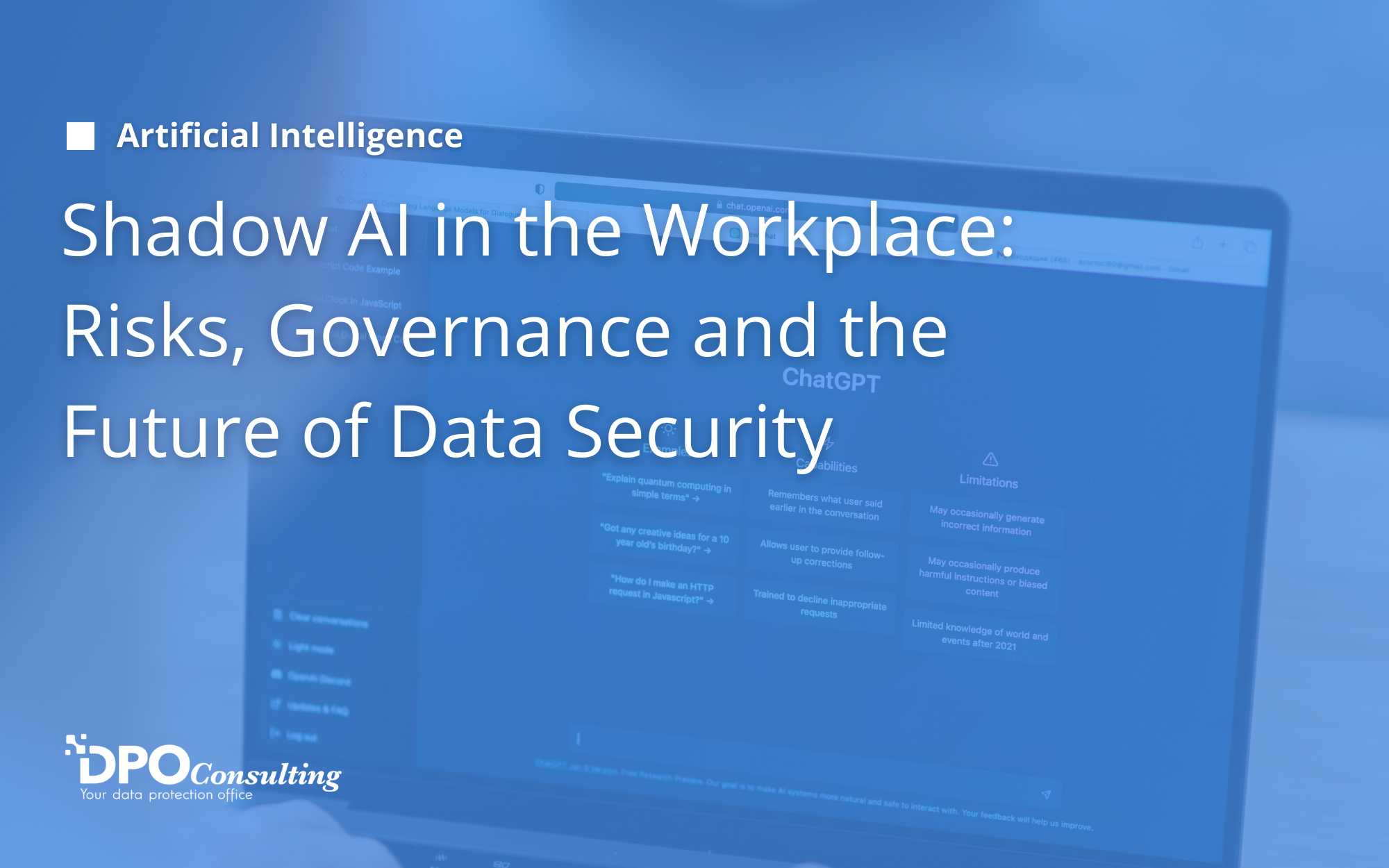
Shadow AI has rapidly emerged as one of the most significant challenges for corporate data governance and cybersecurity.
Sometimes, a simple copy-paste action is enough to weaken the security architecture of a multinational company.
Every day, in quiet open-space offices or remote work environments, similar situations occur.
A financial analyst asks a conversational AI tool to summarise a confidential report. A marketing manager uploads customer data into an image generation platform to refine a campaign. A developer pastes a critical code snippet into an online interface to fix a bug.
Without realising it, these employees may have just opened a breach in the organisation’s digital hull.
This phenomenon is known as Shadow AI — the use of artificial intelligence tools without approval or supervision from IT departments or Data Protection Officers.
What was once a technological curiosity has now become a silent disruption that reshapes cyber governance and forces companies to rethink their internal trust model.
The explosive adoption of generative AI tools is driven by a powerful promise: removing friction from everyday work tasks.
For users, these tools appear almost magical, capable of absorbing the cognitive load of repetitive work.
However, behind their seamless interfaces lies a much more complex issue related to data sovereignty and security.
The problem is not the technology itself but the uncertainty surrounding how the data submitted to AI models is processed.
When employees use public versions of large language models, they often treat them as extensions of their own thinking.
In reality, these tools function as external systems that may process and store the data provided.
This means that:
Traditional cybersecurity governance, built on network restrictions and technical barriers, struggles to address a deeply human behaviour: the search for efficiency.
Completely banning AI tools would likely be a strategic mistake, pushing employees toward unofficial usage and creating invisible risks within the organisation.
The real challenge is therefore not to fight AI but to integrate it within a controlled governance framework.
In response to this shift, traditional security approaches reveal their limitations.
The most resilient organisations understand that AI governance is primarily a matter of corporate culture and internal collaboration.
Rather than imposing strict top-down restrictions, companies must build a trust-based architecture where employees become the first line of defence.
This transformation requires a redefinition of the roles of the DPO and the CISO.
Instead of acting only as gatekeepers, they must increasingly become facilitators of secure and responsible AI usage.
Key initiatives include:
Technology alone is not enough.
The core element remains risk awareness.
Explaining how a prompt could expose confidential intellectual property is far more effective than publishing a long list of prohibitions.
Future cyber governance will therefore be hybrid, combining:
The upcoming European AI Act significantly increases expectations around transparency, risk management and accountability in AI systems.
Organisations will be required to:
However, regulation alone cannot anticipate every scenario.
The true challenge lies in daily operational practices inside organisations.
Companies must become spaces for responsible experimentation, where employees understand both the potential and the risks of AI technologies.
This collective maturity can only be achieved through transparent communication from leadership regarding:
Thinking about AI governance also means acknowledging that the traditional boundaries of the enterprise are disappearing.
While Shadow AI reflects a desire for agility, it also reveals a deeper issue: the integrity of decisions supported by artificial intelligence.
Beyond data leakage, executives are increasingly concerned about the reliability of AI-generated outputs.
If an algorithm:
the organisation may face reputational, legal and operational risks.
This shift forces companies to reach a new stage of digital maturity.
The question is no longer only how to secure infrastructure, but also how to audit the accuracy, reliability and ethics of AI-generated content.
Investing in GDPR compliance efforts can weigh heavily on large corporations as well as smaller to medium-sized enterprises (SMEs). Turning to an external resource or support can relieve the burden of an internal audit on businesses across the board and alleviate the strain on company finances, technological capabilities, and expertise.
External auditors and expert partners like DPO Consulting are well-positioned to help organizations effectively tackle the complex nature of GDPR audits. These trained professionals act as an extension of your team, helping to streamline audit processes, identify areas of improvement, implement necessary changes, and secure compliance with GDPR.
Entrusting the right partner provides the advantage of impartiality and adherence to industry standards and unlocks a wealth of resources such as industry-specific insights, resulting in unbiased assessments and compliance success. Working with DPO Consulting translates to valuable time saved and takes away the burden from in-house staff, while considerably reducing company costs.
GDPR and Compliance
Outsourced DPO & Representation
Training & Support

.svg)